
Clinically reviewed by
Mary Gianatasio, MA in Child Psychology
From the moment babies are born, their nervous systems are already hard at work building the foundation for movement, coordination, sensory processing, and connection with the world around them. One important part of this early development involves primitive reflexes—automatic movement patterns directed by the brainstem that support survival and neurological organization during infancy.
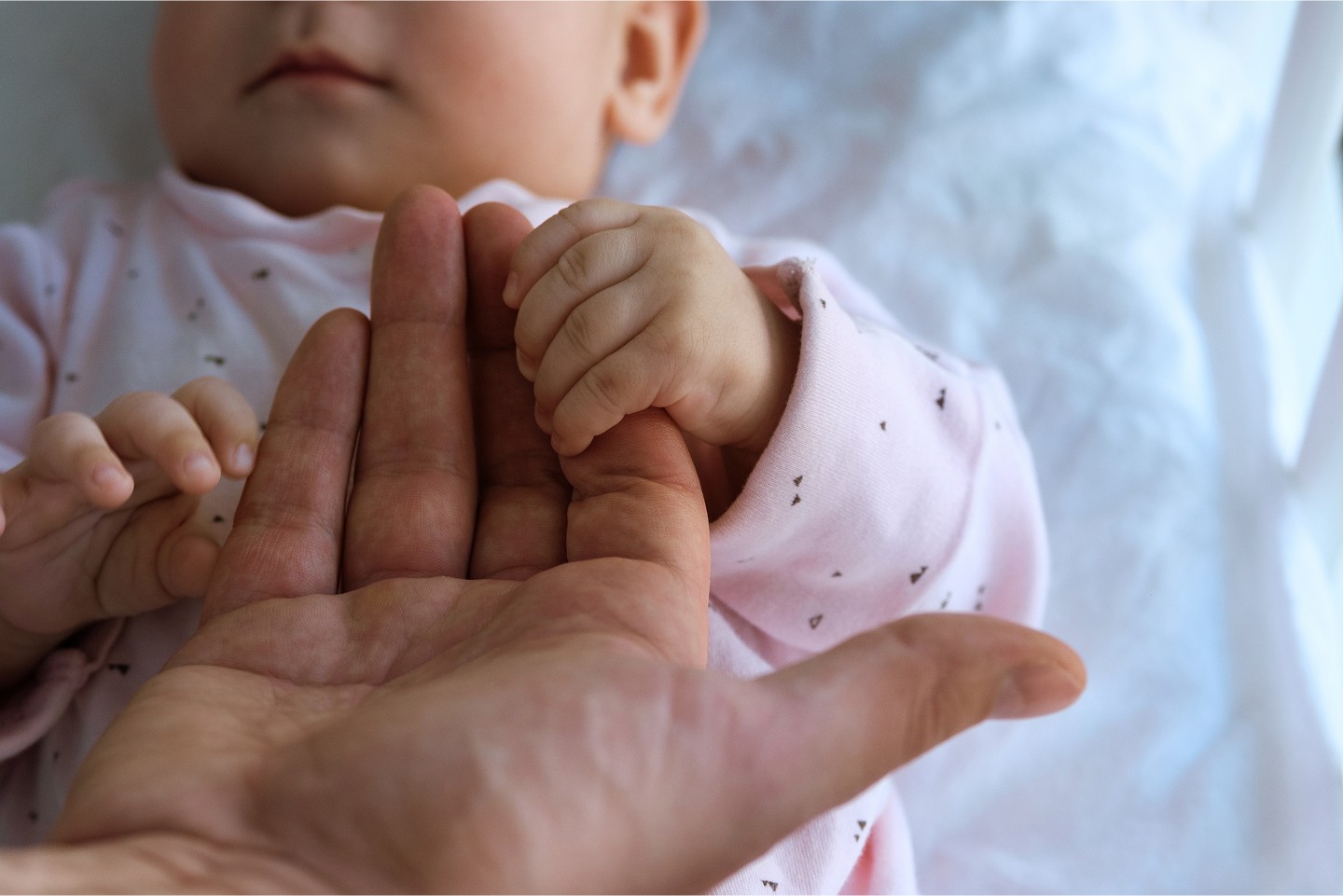
One of the earliest and most recognizable of these reflexes is the palmar grasp reflex. Many parents notice this reflex when their baby tightly wraps tiny fingers around a parent’s finger. While simple, this reflex plays an important role in early sensory and motor development.
What Is the Palmar Grasp Reflex?
The palmar grasp reflex is an involuntary gripping response triggered when pressure or touch is applied to a baby’s palm. In response, the fingers naturally flex and close around the object touching the hand.
Researchers describe the reflex as a primitive prehensile response that begins developing long before birth. According to research, the reflex appears around 16 weeks of gestation and can be observed in preterm infants as early as 25 weeks postconceptional age.
To test the reflex, a caregiver or clinician gently strokes or presses into the infant’s palm. The baby’s fingers automatically close around the stimulus, often creating a surprisingly strong grip.
The reflex involves two phases:
Finger closure around the object or finger
A brief “clinging” action caused by tendon activation in the hand
Interestingly, the thumb is typically not involved in the reflex response.
Why Is the Palmar Grasp Reflex Important?
Although the reflex is automatic, it supports several important areas of early neurological and motor development.
Early Hand and Fine Motor Development
The palmar grasp reflex helps activate the muscles and neural pathways involved in future hand coordination. Over time, these early reflexive movements lay the groundwork for more refined fine motor skills, including:
Reaching
Holding objects
Self-feeding
Writing
Buttoning clothing
Using utensils
As the nervous system matures and develops, reflexive grasping gradually gives way to more intentional and coordinated hand movements.
Sensory and Nervous System Development
The hands contain a large number of sensory receptors that continuously send information to the brain. Reflexive grasping helps infants begin integrating tactile input, movement, and proprioception (body awareness).
This early sensory feedback supports communication between the spinal cord, brainstem, and higher brain regions involved in movement planning and coordination. Repeated sensory and movement experiences help strengthen developing neural pathways involved in motor control, sensory processing, and body awareness. Research on sensorimotor development suggests that the brain can adapt and reorganize through experience—a process known as neuroplasticity—which helps support new movement patterns, learning, and adaptive behaviors over time.
Bonding and Emotional Regulation
The grasp reflex may also support early attachment and co-regulation. Many parents instinctively respond emotionally when a baby grasps their finger, reinforcing connection and physical closeness.
Interestingly, newer research suggests that stimulating the palmar grasp reflex may even help support physiological regulation in newborns. In a 2023 randomized clinical trial, researchers found that palmar grasp stimulation during infant bathing was associated with:
Reduced crying time
Lower heart rate
Improved oxygen saturation
More stable respiratory patterns
Researchers suggested that reflex stimulation may help calm the nervous system during potentially stressful experiences.
When Does the Reflex Integrate?
Primitive reflexes are designed to support development during early infancy and gradually integrate as higher brain centers mature.
The palmar grasp reflex is strongest during the newborn period and typically begins integrating within the first several months of life as voluntary grasping develops.
As babies gain more control over their movements, they begin intentionally opening and closing the hands, transferring objects between hands, and exploring their environment more purposefully.
This transition reflects the growing maturation of the nervous system and the development of voluntary motor control. As babies gain more opportunities for movement, touch, grasping, reaching, crawling, and environmental exploration, the nervous system continues refining the pathways involved in coordination and fine motor development.
In some children, reflex integration may occur more gradually. Researchers and developmental clinicians note that factors such as prematurity, early medical stress, limited floor-based movement opportunities, neurological differences, or reduced sensory experiences may influence how primitive reflexes integrate over time. Reflex patterns are only one small part of a child’s broader developmental picture, and variations can occur for many reasons.
What Happens if the Reflex Persists?
Some clinicians and developmental specialists observe that retained palmar grasp patterns may be associated with challenges involving:
Fine motor coordination and hand use
Difficulty with grasp patterns and object manipulation
Delays in developing more refined hand movements
Sensory sensitivities, particularly involving the hands
Bilateral coordination and motor planning
Hand strength and dexterity
Occasional overflow movements during concentration tasks, such as mouth or tongue movements while using the hands
As children grow older, these patterns may sometimes contribute to challenges with tasks such as handwriting, utensil use, dressing skills, or sustained fine motor activities.
Retained primitive reflexes are not considered diagnoses on their own, but they may offer insight into how the nervous system is organizing movement, sensory processing, and motor coordination. Sometimes retained reflexes may appear alongside other reflex patterns or developmental differences that affect posture, coordination, attention or sensory regulation.
If concerns arise regarding motor development or coordination, a pediatrician, occupational therapist, or developmental specialist can help evaluate whether additional support may be helpful.

An Integrative Perspective on Motor Development
From an integrative perspective, fine motor development is influenced by much more than the hands alone. Sensory processing, posture, muscle tone, nervous system regulation, adequate nutrition, sleep and circadian rhythm, movement opportunities, and environmental experiences all contribute to healthy neurological development.
Fine motor development does not occur in isolation. Hand coordination is closely connected with postural control, shoulder stability, sensory processing, visual-motor integration, and nervous system regulation. This is one reason why whole-body movement experiences—including crawling, reaching, climbing, and floor-based play—can support the development of more refined hand skills over time.
Research on early sensorimotor development suggests that varied movement and sensory experiences help strengthen communication between the body and brain. Opportunities for touch, movement, balance, grasping, crawling, and environmental exploration may support the development of adaptive motor patterns and self-regulation over time.
Supporting fine motor skills often involves supporting the whole child through:
Floor-based movement and play
Tummy time and crawling opportunities
Natural movement experiences, including babywearing, reaching, rolling, and free floor play
Sensory-rich experiences with varied textures, sounds, and movement
Gentle tactile experiences involving the hands, feet, and face
Adequate sleep and nervous system regulation
Nutrient-dense nutrition for brain and neuromuscular health
Opportunities for grasping, squeezing, stacking, and manipulating objects
Age-appropriate sensory tools and movement breaks that support regulation and body awareness during play or seated activities
Simple daily activities—such as tummy time, finger feeding, textured toys, stacking blocks, crawling games, climbing, drawing, sensory bins, or supervised messy play—can help strengthen both motor pathways and sensory integration in developmentally supportive ways. Exposure to a variety of sights, sounds, textures, and movement experiences helps the developing nervous system practice coordination, regulation, and body awareness through everyday play.
When Should Parents Seek Support?
Parents may occasionally notice signs such as excessive hand tension, awkward pencil grip, fatigue during fine motor tasks, or unusual mouth movements while concentrating. While these observations do not confirm a retained reflex, they may help guide conversations with a pediatrician or occupati onal therapist if concerns arise.
Every child develops at their own pace, and variations in reflex integration are common. However, parents may wish to seek guidance if a child experiences persistent difficulties with:
Fine motor coordination
Hand strength
Handwriting
Grasp patterns
Motor planning
Sensory sensitivities
Developmental milestones
Occupational therapists and developmental specialists can help assess motor development and provide supportive strategies tailored to the child’s individual needs.
Final Thoughts
The palmar grasp reflex is one of the earliest signs of the developing connection between the brain, nervous system, movement, and sensory experience. Though often noticed simply as a baby gripping a parent’s finger, this primitive reflex plays an important role in laying the foundation for future fine motor coordination and neurological development.
By supporting healthy movement, sensory experiences, nutrition, sleep, and responsive caregiving, parents can help nurture the strong developmental foundations that support learning, coordination, and emotional resilience as children grow. Small, everyday sensory and movement experiences can play a meaningful role in helping the developing nervous system build the connections that support lifelong motor and cognitive development.
References
Anekar AA, Bordoni B. Palmar Grasp Reflex(Archived). 2024 Sep 10. In: StatPearls [Internet]. Treasure Island (FL): StatPearls Publishing; 2026 Jan–. PMID: 31985926.
Falkson SR, Bordoni B. Grasp Reflex. [Updated 2025 Jan 22]. In: StatPearls [Internet]. Treasure Island (FL): StatPearls Publishing; 2026 Jan-. Available from: https://www.ncbi.nlm.nih.gov/books/NBK553125/
Kadiroğlu T, Koç ES. Effect of Palmar Grasp Reflex Stimulation on Physiological Parameters and Crying Time During Neonatal Bath: A Randomized Controlled Trial. Biol Res Nurs. 2023 Jan;25(1):33-40. doi: 10.1177/10998004221113765. Epub 2022 Aug 13. PMID: 35968725.
Futagi Y, Toribe Y, Suzuki Y. The grasp reflex and moro reflex in infants: hierarchy of primitive reflex responses. Int J Pediatr. 2012;2012:191562. doi: 10.1155/2012/191562. Epub 2012 Jun 11. PMID: 22778756; PMCID: PMC3384944.